

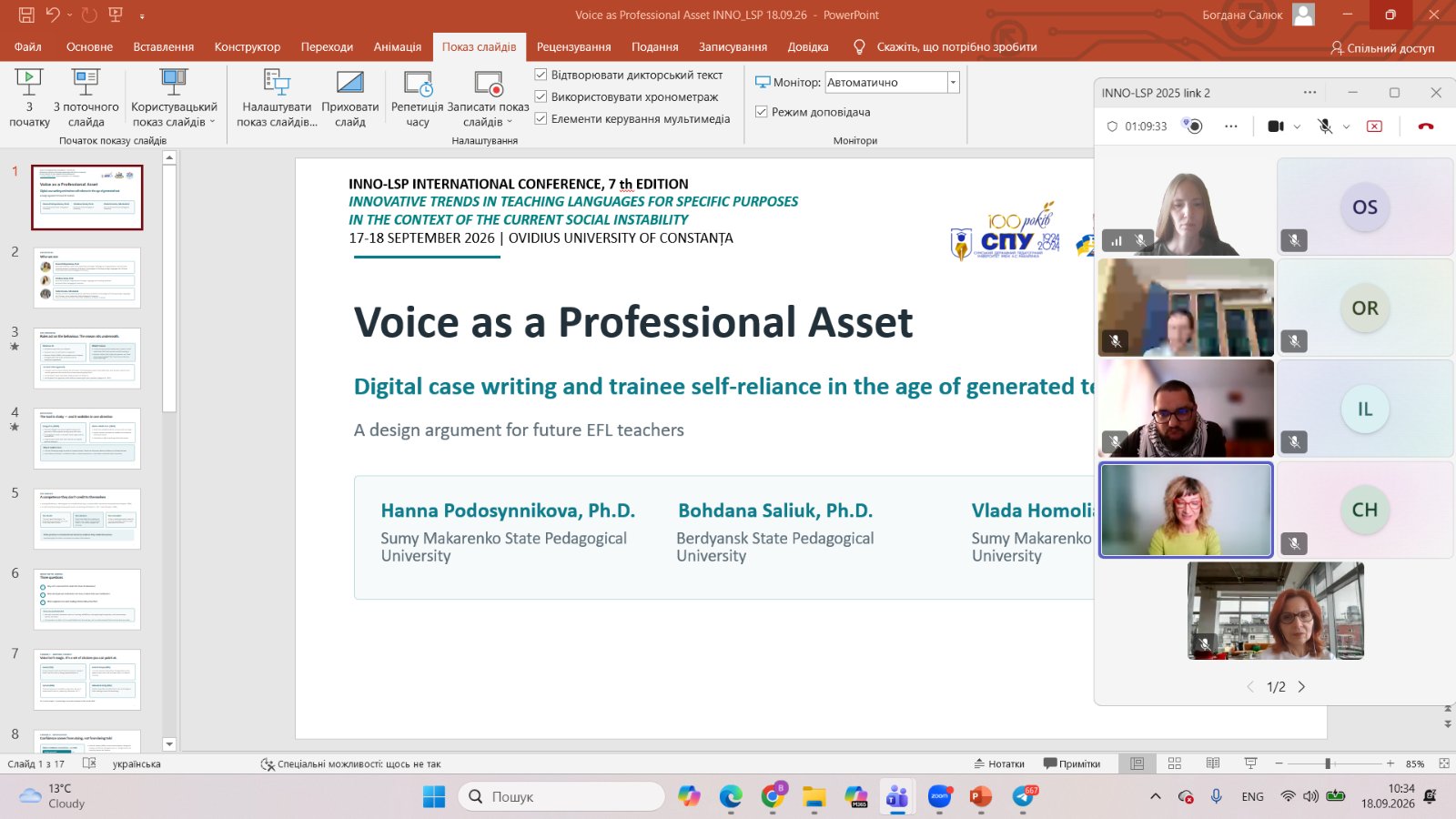



The Department of English Philology and Linguodidactics and the Inter-University Research Laboratory of Modern Technologies of Teaching Foreign Languages and Cultures of Sumy State Pedagogical University named after A.S. Makarenko took an active part in the 7th Edition of the International Conference "Innovative Trends in Teaching Languages for Specific Purposes in the Context of the Current Social Instability" (INNO-LSP), held on 17–18 September 2026 and hosted by Ovidius University of Constanța, Romania.
The team – Hanna Podosynnikova, Ph.D. in Education, Associate Professor, Head of the Department of English Philology and Linguodidactics, Head of the Laboratory; Bohdana Saliuk, Ph.D. in Comparative Literature, Associate Professor, Berdyansk State Pedagogical University; and Vlada Homolia, M.A. student, Member of the Laboratory – delivered two presentations on 18 September, both of which attracted considerable interest from the international academic community.
In the first presentation, "Voice as a Professional Asset: Digital Case Writing and Trainee Self-Reliance in the Age of Generated Text," they argued that prohibiting and detecting AI writing tools addresses the behaviour but not what drives it. One of the main reasons trainees turn to these tools is rarely discussed: doubt that their own account is worth submitting. A ban does not remove that doubt, and strict enforcement can even reinforce it. The speakers introduced a case-writing sequence in which trainees first write their own draft and only then compare it with AI-generated text, looking at what the system could not have known, where it hedged, and where plausibility replaced evidence. Through this comparison, future teachers discover their own irreplaceable contribution: the detail they noticed, the inference based on knowing a particular learner, the decision they are responsible for. The team also shared their assignment design, assessment criteria that value visible reasoning over polish, and trainees' own reflections on the parts of a case only they could have written.
In the second presentation, "Speech Idiomaticity as a Mirror of Verbal Mentality: Building Intercultural Competence in Future English Teachers," they showed that speech idiomaticity goes far beyond fixed figurative expressions. It includes a wide range of constructions specific to a speech community that reflect its speakers' verbal mentality and worldview, and that often challenge foreign-language learners. The presenters argued that reflective practice helps future English teachers turn awareness of these constructions into intercultural competence. Students reconstruct the cultural motivation behind a construction, explain why something is said one way in one community and differently in another, and interpret their own hesitations or mistakes as signs of a different verbal mentality rather than simple lexical errors. The team discussed cognitive-communicative and collaborative learning strategies, the difficulties of developing these skills, the scaffolding such work requires across a course, and possible ways to assess the competence achieved.
Congratulations to the team on two forward-looking and practice-oriented contributions to EFL teacher education!