

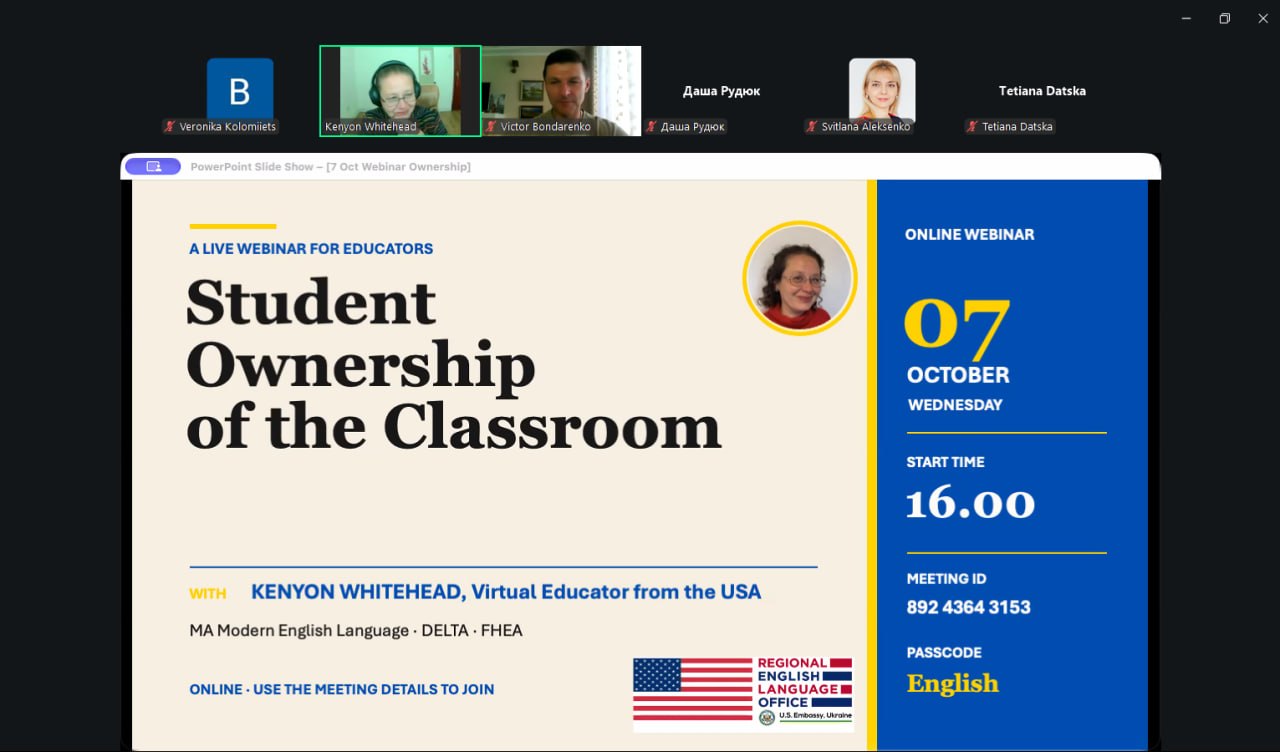
On October 7, 2026, the webinar “Student Ownership of the Classroom” was held online on the Zoom platform. It was led by Kenyon Whitehead, virtual educator of the Department of English Philology and Linguodidactics of the Faculty of Foreign Languages and Social Sciences (FISF) of Sumy State Pedagogical University, within the framework of The Virtual English Language Educator Program, implemented with the support of the Regional English Language Office of the U.S. Embassy.
The meeting was attended by faculty members and students of the department, including the project coordinator, Viktor Bondarenko, Candidate of Philological Sciences, Associate Professor.
The central issue of the webinar was the concept of “ownership”: students’ sense of involvement in, and responsibility for, their own learning process. Ms. Whitehead invited participants to consider what makes such ownership possible and to analyze its main factors together: access, understanding, permission, confidence, and safety. Participants discussed which of these conditions a teacher can create directly in the classroom and which require a broader educational environment.
A separate part of the session was structured as an interactive poll. Participants were asked to identify which situation demonstrates the highest level of student ownership: a student chooses a partner, chooses a topic, asks a question that changes the course of a discussion, proposes a project idea, or takes part in creating assessment criteria. The participants’ answers revealed different approaches to understanding learner autonomy and prompted a lively discussion. At the end of this block, the educator invited those present to reflect on which of these types of student initiative they feel most comfortable working with right now.
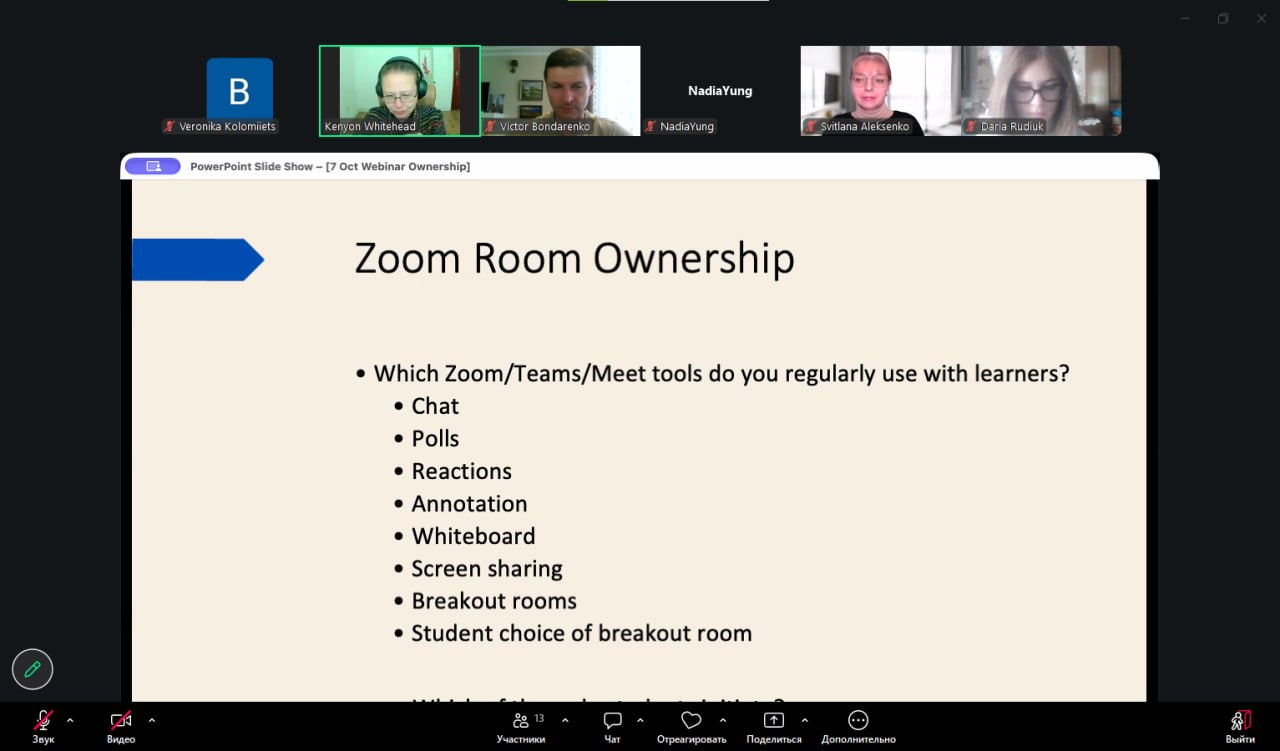
The practical part of the webinar focused on online platform tools (Zoom, Teams, Meet) that promote student engagement: chat, polls, reactions, annotation, the interactive whiteboard, screen sharing, breakout rooms, and the option for students to choose a breakout room themselves. Participants shared their experience of using these tools and considered which of them allow teachers to hand over initiative to students during a lesson.
The webinar was a valuable opportunity to exchange experience and to reflect on how to turn students from passive listeners into active participants in the learning process. The Department of English Philology and Linguodidactics expresses its sincere gratitude to Ms. Kenyon Whitehead for a substantive and practice-oriented meeting, and to the Regional English Language Office of the U.S. Embassy in Ukraine for supporting the project.